
In 1738 a Swiss scientist by the name of Daniel Bernoulli discovered some interesting facts about air pressure. His findings are now known as Bernoulli's principle, and can explain why a bird or air plane can fly. Here is the science behind flight:
An airplane wing is relatively flat on the bottom and convex (curved) on the top. When an airplane is moving forward through the air, the air flowing above or over the wing has farther to go in a given amount of time than the air beneath the wing (the shortest distance between two points is a straight line, i.e., beneath the wing; the distance above the wing is longer because it is not in a straight line). Because of this difference in the flow of air, the air pressure is greater below the wing than above it, and the air plane is pushed up. Pretty cool, huh?
Here is a simple experiment you can do right now to test Bernoulli's principle, just click on the link below:
It is almost time for my flight to Toronto, Ontario (Canada) and then to Saint John, New Brunswick (Canada). I will not arrive until late tonight, so this may be my only post for the day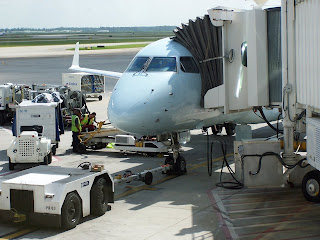 .
 .

